🧪From Snake Oil to Science: America’s Long Road to Modern Pharmaceuticals
What began as a marketplace of potions and promises transformed into a regulated, research-driven enterprise grounded in chemistry, biology, and public trust. This is the beginning of how American medicine found its soul in science.
10/16/20253 min read
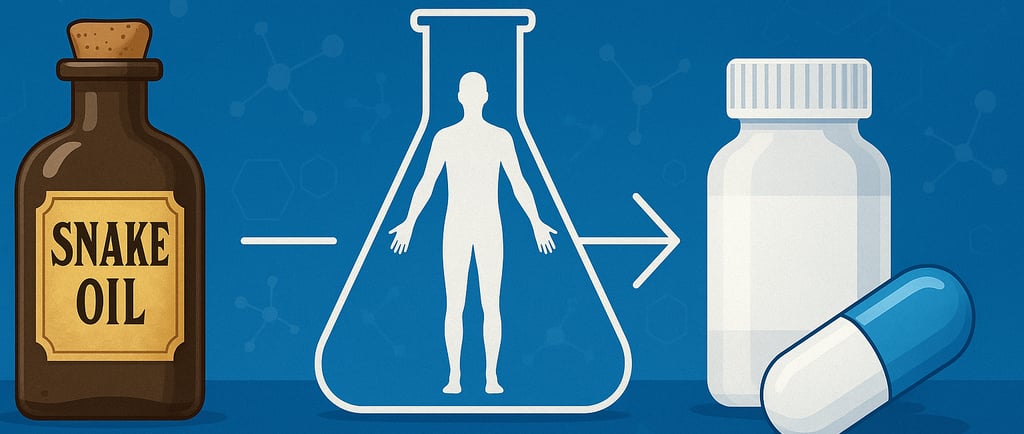
America’s rise as a global leader in drug development didn’t happen overnight. It was a slow, uneven climb—from the chaotic world of 19th-century “heroic medicine” and patent potions to the modern, highly regulated pharmaceutical industry.
The story of U.S. medicine is as much about fraud as it is about progress—a tale of snake oil and science, greed and discovery, and the long awakening to the need for public protection.
🩺 Medicine Before Science
At the dawn of the 19th century, American medicine was a patchwork of folklore, faith, and experimentation. Doctors prescribed tinctures of herbs, mercury, or animal fat. The most common treatments—bloodletting and purging—were brutal.
As medical historian Charles Rosenberg once noted, the ritual of care mattered more than the cure itself. The doctor’s visit and the “gift of a draught” gave comfort, even if the remedy harmed more than it healed.
⚖️ The Age of Heroic Medicine
By the early 1800s, physicians embraced what became known as “heroic medicine”—treating illness with aggressive, often dangerous interventions. George Washington died after repeated bleedings; Abraham Lincoln suffered chronic mercury poisoning from his “blue mass” pills.
This brutality sparked public backlash. Patients began seeking gentler alternatives—homeopathy, tonics, and “patent medicines.” Medicine was no longer a privilege of the elite—it became a consumer market.
🧴 The Patent-Medicine Era: Quackery and Commerce
By the mid-19th century, patent medicines—alcohol- and opium-laced tonics promising to cure everything—dominated the market.
Advertising was powerful, and regulation was nonexistent. Addiction spread quietly, marketed as relief. Only with the 1906 Pure Food and Drugs Act did Congress finally intervene, banning the most dangerous and deceitful products.
That law marked the first serious step toward what we now call drug regulation—a response not to theory, but to scandal.
⚙️ Industrialisation and Poison
The industrial revolution brought chemistry—and danger. Factories churned out new compounds faster than science could study them. Cheap dyes became the precursors of synthetic drugs, while unlabelled poisons filled medicine cabinets.
To reduce accidental deaths, manufacturers began bottling toxins in cobalt or green glass, embossed with skulls or ridges. Even this led to unintended consequences—children were drawn to the colorful bottles.
Each tragedy taught the same lesson: science without safeguards could be deadly.
🌿 The Botanical and Chemical Revolution
Despite chaos, real breakthroughs emerged.
Cocaine was isolated from coca leaves (1860).
Salicylic acid, the basis for aspirin, came from willow bark (1874).
Quinine from cinchona bark treated malaria.
Digitalis and strophanthin were purified for heart disease.
Chemistry entered medicine decisively. Bayer’s Felix Hoffmann synthesized aspirin in 1897—arguably the first modern drug.
What had begun as folk healing now rested on molecular precision.
🔬 Germ Theory and the Microbe Hunters
The 19th century’s defining scientific leap was germ theory.
Louis Pasteur, Robert Koch, and Joseph Lister transformed medicine by proving that invisible microbes caused disease. Their discoveries reshaped hospitals, surgery, and sanitation.
But in America, old beliefs died hard. Many physicians dismissed germ theory as “European nonsense.” Yet vaccines, antitoxins, and public-health successes soon forced a reckoning. Science had won.
💉 The Birth of Immunology
Pasteur’s 1885 rabies vaccine proved immunity could be induced safely.
Soon after, Emil von Behring and Shibasaburo Kitasato demonstrated “passive” immunity—using antibodies to cure diphtheria and tetanus. By 1892, industrial-scale production of antitoxins had begun.
For the first time, medicine was scientifically reproducible. Laboratories replaced apothecaries. Governments built oversight institutions. Regulation—still minimal—had found its moral justification: protecting public trust.
⚗️ From Dyes to Drugs
In 1856, a teenage chemist named William Perkin accidentally created mauve, the first synthetic dye. It sparked a wave of industrial chemistry.
By the 1880s, Germany and Switzerland led the world in turning dyes into drugs. Bayer’s factories synthesized painkillers like phenacetin and, later, aspirin.
In America, machinery caught up fast: Wyeth’s rotary tablet press (1872) and X-rays (1895) allowed mass production and precision testing. Industrial chemistry and biology were merging—the blueprint for the modern pharmaceutical industry.
🧫 Sanitation, Science, and Prejudice
Public health became political. Immigration, urban poverty, and disease outbreaks fueled prejudice. Immigrants were scapegoated as “vectors of contagion.”
Yet amid the fear, the U.S. took decisive steps forward:
The Hygienic Laboratory (1887)—the forerunner to the National Institutes of Health—was founded.
The Biologics Control Act (1902) established the first federal oversight for vaccines and antitoxins.
The Pure Food and Drugs Act (1906) followed, codifying safety as a national priority.
The foundation of modern biomedical governance was set.
🧠 From Chaos to Codification
By the dawn of the 20th century, America had transformed its medical identity.
What began as a marketplace of superstition and snake oil had become a field of industrial research and professional standards. Chemistry, biology, and regulation had converged.
But progress came with contradictions—addiction crises, prejudice, and uneven access persisted.
Still, the architecture of the modern drug system was in place:
Science as foundation
Industry as engine
Regulation as safeguard
🌟 The Pharmaceutical Century Beckons
The 19th century was medicine’s messy adolescence—chaotic, creative, and essential.
By 1900, America had built the infrastructure that would define the “pharmaceutical century” to come: rigorous testing, industrial production, and public accountability.
It was the end of one era—and the beginning of another:
From snake oil to science.
💬 Question: How can today’s innovators avoid the same trap—letting regulation lag behind discovery or greed overtake trust?