💊 America’s Medicine Future: Can We Still Lead the World in Drug Discovery?
The U.S. once set the global pace in drug discovery. Now, as China accelerates and our own innovation engine slows under regulation, the question isn’t can we lead again—it’s whether we’ll have the courage to reinvent how we govern science itself.
10/28/20252 min read
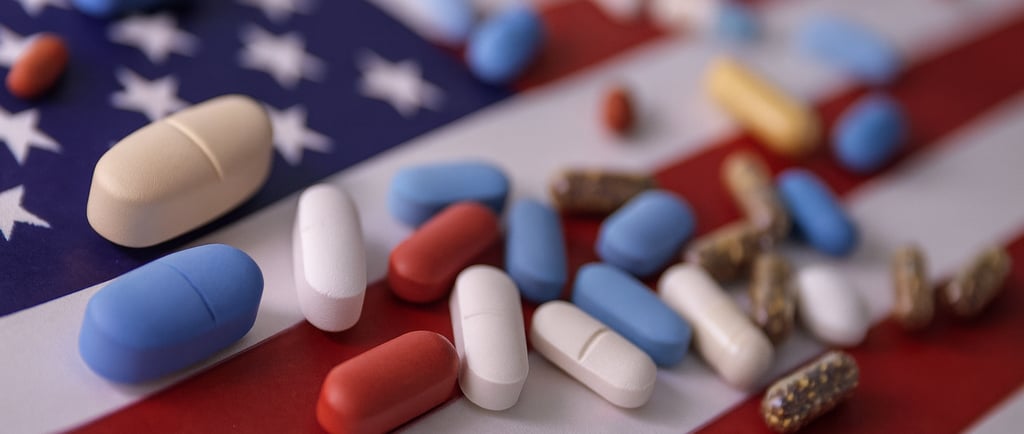
For most of the past century, the United States has been the superpower of medical innovation. Our universities, entrepreneurs, and regulators built the modern pharmaceutical industry—and gave the world penicillin, insulin, chemotherapy, statins, and the COVID-19 vaccine.
But that supremacy is under threat. What was once a nimble engine of discovery has become a lumbering bureaucracy. Drug development today takes, on average, 10 years and over $2 billion. Every safeguard added for safety has also added friction.
Caution—once a virtue—has become paralysis.
⚗️ From Breakthroughs to Bottlenecks
America’s rise was built on a simple social contract: Regulators ensured safety and efficacy while giving scientists room to take risks.
That balance has tipped. Decades of well-intentioned reform have layered on complexity until innovation itself became the casualty.
🧪 When “Me-Too” Replaces “Breakthrough”
Faced with rising costs and regulatory uncertainty, companies hedge their bets. Instead of bold, first-in-class discoveries, they invest in “me-too” drugs—incremental tweaks to proven molecules that are easier to approve.
The paradox? The more sophisticated and risk-averse our regulatory system becomes, the fewer transformative therapies it produces.
🌏 The World Is Catching Up
Meanwhile, global competitors are moving fast. In China, government-backed investment and streamlined regulation have turned cities like Shanghai and Suzhou into biotech hubs. Clinical trials that once ran in Boston or San Diego now increasingly run in Asia—where recruitment is faster, costs are lower, and regulators move quickly.
Former FDA Commissioner Scott Gottlieb recently warned in the Washington Post:
“One-third of the novel compounds entering U.S. pipelines now originate from Chinese biotech companies. Within fifteen years, more than a third of new FDA approvals will trace their lineage to China—up from five percent today.”
This is not a scientific defeat—it’s a policy one. China’s advantage isn’t better science. It’s faster execution.
🚀 Reclaiming America’s Edge
The U.S. can regain leadership—but only if it modernizes its regulatory mindset.
Here’s how:
1️⃣ Data-Driven Regulation – Use real-world evidence, AI models, and digital twins to detect safety signals early and cut trial timelines.
2️⃣ Risk-Proportionate Oversight – Match regulatory scrutiny to therapeutic risk.
3️⃣ Adaptive Approvals – Expand the COVID-era playbook that enabled emergency authorizations and iterative review.
These are pragmatic fixes—not revolutions. They simply restore what once worked: science guided by prudence, not paralyzed by procedure.
🔬 The Next Golden Age of Medicine
Medicine today is as much information technology as chemistry. AI predicts protein structures. CRISPR edits genes. Precision medicine personalizes treatment down to the molecule.
The opportunity is enormous—if policy can keep up with science.
America still has unmatched assets: World-class universities. Deep capital markets. Entrepreneurial culture.
What it lacks is a regulatory system built for the 21st century—one that’s transparent, data-driven, and as innovative as the science it oversees.
The nation that learns to move fastest—without losing trust or rigor—will define the future of medicine.
The U.S. once showed the world how innovation and regulation could work in harmony. We can do it again.
💬 Question: If you could change one thing about how the U.S. develops and approves new medicines—what would it be?